Showing posts with label Jaipur. Show all posts

Thursday, 1 May 2008

Bikaner Bound

Wednesday 23rd April

- Nahagarh Fort
- leaving Jaipur - Take Two
- (finally!) arriving in Bikaner

late rising after a thorough reboot, we threw caution to the wind and had a breakfast on the roof in the same seats as the previous day. we prevaricated a little as to whether or not we were going up to the Nahagarh (or 'Tiger') Fort, built - as seemingly everything in the area had been - by our old friend Jai Singh II in 1734. of the designated 'sights' in Jaipur, it was the one remaining still that we had an interest in seeing. by the time that we decided to go, it had somehow got to 10:30am and, of course, much hotter.

Nahargarh Fort, lording it over Jaipur.

we bartered with the manager of a few auto-rickshaws for the fare to the base of the steep escarpment where a path leads up to the fort, balancing above the city below. although the light at that time of day was extremely bright, we still thought that the views would be worth it, even though we had read that the fort was generally in ruins. the auto-arranger's nose appeared to have been half sucked back into his face, which seemed to make haggling with him a little more difficult, but we got a reasonable price and set off with a man named Sharm. actually, when first asked he said his name was 'Dudley Moore,' so we may be wrong on that.

when we got to the base of the climb along the same Northern road that our Des Lynam-esque driver Ravi had taken, we decided that it might not be such a good idea to take the steep path up to the fort in the heat. the practicalities of defence make for impractical ascents to many of these forts! we renegotiated to be driven to the fort, which - a little gallingly - involved taking the winding hill road (the only one in the area) that ran right past the entrance to the Jaigarh Fort. if we'd known, we might have been able to visit it on the same day as when we toured Amber. but the road continued to offer spectacular views of the 'Water Palace' and surrounding hills, all of which seem to have crumbling rampart walls running along them like the spine of some giant stone snake.

view from the top, featuring the 'Water Palace'

at the gates, Sharm gave us a master class in histrionic Indian negotiation as he refused to pay an extra 5 Rupees more than legislated that the entrance guards demanded if he wanted to drive in - so we walked the short distance to the main fort area after his skills had been exhausted. the main palace is the only part of the fort that is in any sort of good condition, but we were in for a surprise when we saw the extent of the carved and mainly painted rooms, resplendent in yellow with blue and turquoise touches and highlighted with semi-circular stained glass windows.

Nahargarh Fort (detail)

Nahargarh Fort (detail)

Nahargarh Fort (detail)

Nahargarh Fort (detail)

gratuitous monkey shot

peering through those that were open and past the odd grooming monkey, Jaipur is laid out before you.

after a near vertical drop, a higgledy-piggledy conglomeration of grey and blue flat topped buildings spreads out until the grid layout of the Pink City takes over, with the yellow City Palace and Jantar Mantar observatory in the centre and the path to Galta in the haze in the far distance.

the extent and relatively good condition of the palace apartments were a pleasant surprise, contrasting nicely with the tumbledown nature of the rest of the fort.

some ramparts in particular had given way and slid in pieces down the escarpment, creating a more hazardous walk than we had intended as we toured their remains.

rooftop walkway, Nahargarh Fort, Jaipur

with a train to catch - again - we walked out to where Sharm was parked under a banyan tree, its huge branches hanging with bunches of roots way off the ground, a curious cross between a weeping willow and a mangrove swamp.

banyan tree and cows

then it was back down the mountain road for the last time, skirting goat herders with their flocks, many of whom were still making the highly arduous climb they had been commencing when we drove up, and would be for still many hours to come.

packing, resting briefly and checking out then followed in quick succession (the staff at the Sunder have been very good). we were pleased to also bump into Chris and Abby as we left; like them, we hoped - in the nicest possible way - that we would not see them again this day.

one auto later and we were back in Jaipur station, this time on a different platform, and again standing in front of a train with no English signage and already full of people. it took a lot of questions before we ascertained that it was indeed the Bikaner train; a lot more managed to locate our carriage; a final group got us in the correct carriage. we had not know it when we booked, and neither had we requested it, but we were in our first 2nd class sleeper carriage, arranged as two bunks facing each other crossways, forming 'compartments,' and another two longways across a narrow aisle.

the trick is to have the top one. only you may use that, whereas the bottom bunk seats three if all spaces are taken, and the back rest folds up to form a middle bunk as well. we managed to have one bunk and a seat right around in the next compartment, not great if either of us wanted to sleep and have the other nearby (although probably more of an issue for Philippa, due to Edd's size). we locked the bags together on the top bunk and sat next to each other, hoping there'd be room. three grey ceiling fans in each compartment spun continuously, rotating so fast that only the noise indicated the presence of any blades, otherwise invisible. all else was sky blue painted metal, with thin, plastic coated seats - good enough for short journeys, possibly, but seven hours lay ahead.

we set off at the appointed time with the train's horn blaring at length (unlike yesterday), still not 100% sure that we were on the correct one. the conductor stored his bag next to us, which was strangely comforting, although he had only just tried to turf out a whole family and their mentally disabled son so that we could have adjoining seats, something that we could just not agree to! although busy to start with, the train's passengers steadily thinned out enough that we didn't have to separate during the journey (aww!).

it felt like all of its seven hours. relieved to be mostly on the side of the train that was out of the sun's rays, we watched the landscape spread out through the horizontally barred windows. unlike other cities we had departed, the trackside communities on the route leaving Jaipur were few and short-lived, swiftly making way for a more parched landscape of strangely tufted trees marooned in fields of ploughed stones, each with its own small white painted shrine. at one point even this vanished, leaving only large salt flats, some coated in blue, red and purple coils of liquid. shortly after, we passed through a town that was given over to the processing and packaging of salt, full of many small yards containing precise pyramids of crystals laid out next to massive white mounds. still later, we cut through a mining town, possibly Makrana Junction, where women sold pot stands through the train windows from a pile balanced on their heads. exiting the station, the ground gave way next to the track and opened up into a huge, man-made valley, jagged edged and fringed with primitive pulleys and excavators. the reason for such large scale gouging was to be found in the rough hewn surface of the chasm and the constant dusting of stone chips at the edge of the track - marble. it was from here that the Taj Mahal's white marble originates and, from the numerous other, smaller quarries that we passed, it seems to remain a key part of the town's economy. many of the excavations came right up to the edge of the tracks.

even when full, the train was not a too unpleasant place to be. a street child got on at one point and danced up and down the narrow aisle, passing herself through a hoop that could have been
no more than a few inches in diameter before asking for donations. people cooked and ate while playing cards in family groups, others slept, more stood in the open doorways, catching the air or admiring the views. Edd tried this himself, but a lot more practice would be requored beforeyou could feel even remotely safe! as night fell, the train emptied with each relatively infrequent stop, but its passengers remained smiling and passing on goodwill gestures to us, the only visible Westerners on the train. one man also on his way to Bikaner asked us where we were going. 'Bikaner,' we replied. 'Why?' he said smiling, his voice filled with good natured bemusement. as we head further into the heat of Rajasthan, this is becoming more and more common!

as we neared Bikaner, the train's interior was coated with a fine sand spotted with mostly dead flies as it went through a couple of minor dust storms.


by the time we finally arrived, late, at 11:30pm, all our belongings were coated in it, even using the windows' storm shutters. we walked the short distance from the railway station to our hotel, the Marudhar Heritage. first impressions were not wildly positive, as the place at night exuded a certain charmless, municipal feel, but the room had powerful AC (even if it was carpeted, of all things) and the very busy city at night was extremely warm, at least 32C, according to the thermometer in reception. by the time we had checked in and cleaned up, it was past 1am. once again genuinely fatigued at the end of a day's travel, not even our room's inappropriate suburban Indian restaurant patterned wallpaper cold stop us falling to sleep.

our best to all readers!

edd & philippa

A Comedy of Errors

Tuesday 22nd April

- new friends
- leaving Jaipur - Take One
- a fine, consolation dinner

over a mouth-bursting pineapple pancake, we breakfasted on the roof of the hotel at one of the two tables not pulverised by the sun. our sleep had been deep and refreshing and our morning considerably enriched by our meeting with Chris and his wife Abigail at the breakfast table. four months into a year-long trip around the world, the British couple were laid back, engaging, open and most of all fun. we swapped stories and chatted for ages and it was only the advancing morning and our list of things to do that made us break off such a meeting of the minds. although we all had plans, we hoped that we would manage to see them again before we left Jaipur. as it transpired, we were to see quite a lot more of Chris and Abby before we were to finally quit the Pink City.

a required visit once more to the GPO to lighten our packs of their new and awkward to fit souvenirs (camels are hell to pack) resulted in another two hours of patience, endurance and extraordinarily accurate cotton tearing and sewing by the highly skilled and supremely dextrous yet rather unhurried parcel packing supremo. having changed the lines from our last visit, we thought that we had another hour at least of queuing, but the man at the enquiries desk cheerfully told us to push in at the very front of the queue ahead of around 40 Indians. favouring feminine wiles over masculine size, Philippa did so and was served immediately, and to no apparent recriminations! sometimes it's difficult to work this country out.

sheltering from the midday sun as much as we could in the streets, we went back to the Sunder Palace, hoping that we might encounter Chris and Abby one last time before leaving Jaipur for Bikaner. we did manage to hook up again for some rooftop thirst quenchers. having already toured around Southern Africa and Nepal, they were now spending some time in India before Cambodia and Laos. relaxed and with the confident, flexible air of those who have been on the road for some time, we hoped that we too would have such an unhurried and good natured attitude after months of our own travels! sometimes it can still feel like we are trying to see all of India at once, but the heat of the day and the sheer size of the country is slowly doing its work and, in the case of Edd, not unpleasantly beating the stressed Londoner in him into relaxed submission.

it was great to chat with them and pick up tips and suggestions, although we may have got more out of it in that respect than they! once more our schedule forced us to part, as we had to catch the 3:50pm train to Bikaner, a 7 hour journey West then North to what would be the furthest North into the country that we would be travelling.

we arrive at the station in very good time and found the correct platform, but there was another, later train already on it. there then followed some protracted running around as we tried and failed to get any consistent information or answers as to where our train might be found, or when it would arrive. it is not part of Indian culture to say 'No,' so people will usually give you an answer rather than say that they do not know, even if that answer is a guess or completely incorrect.

the time for our train came and then went, but there was still no sign of it that we and a Dutch tourist also seeking it could find. with minimal announcements, few in English and unhelpful digital readouts - which makes Jaipur quite an advanced Indian rail head - we frantically tried to find our carriage to Bikaner. unfortunately, by the time that we discovered that our train was at the end of the very long, same platform but positioned after one or two other trains that were also at that platform, our despairing luggage laden run only offered amusement to those still waiting on the platform. the Dutch guy had apparently had more luck, but we had missed our train, even though we had been less than 500 metres from it for an hour and more.

a period of venting born of physical exhaustion and discomfort married with deep frustration and anger at our own stupidity then commenced, until common sense, practical concerns and a recognition of the futility of such actions took over, no doubt to the disappointment of the avid audience we had managed to attract. Indians do love a good argument and will encircle any they find hoping for some action. we found at STD phone and booked ourselves back into the Sunder Palace before trudging with impotent fury to the booking hall to try again to get the next train. the hall was mercifully quieter than before, we used one of our duplicate train forms kept for just such an eventuality and managed to get seats on the next day's afternoon passage, quite an achievement considering that the marriage season and forthcoming summer holidays means that a great many people are currently travelling by train. all that was left to do was to hail a rickshaw and head back again to the hotel, feeling a sheepish and sorry for ourselves.

we staggered into reception to the considerable surprise and bemusement of the hotel's helpful and friendly staff, and also of Chris and Abby, who were also there. but, as Chris pointed out, it did mean that an opportunity for dinner had arisen! India - and life, too, if it's not stretching the analogy too far - is a land of doors that open when others close and abundant silver linings around its undoubted occasional clouds.


Chris, Abby and Phil (Edd is taking the photo,
having forgotten he has a self-timer facility on his camera).

a cleansing shower and time to reflect and cool down were squeezed in before Chris called us for dinner. we considered eating at the Sunder, but the Pearl Palace was cheaper, so we headed around the corner. standing outside was the snake oil receptionist, who on seeing us immediately launched into some story about holding a room open for us and wondering where we were, even though it was his slippery voice with which we had spoken on the phone. while our originally scheduled Bikaner train approached its destination, we had some good food and fine companionship with new friends, with even a few beers thrown in. a celebration of Chris' birthday in Gujarat in two weeks' time seemed a marvellous idea but a bit of a stretch on our current timetable, but we were sure we would make the effort to see them again, even if we would have to wait until we were all back in England.

home to the Sunder for bed, sleep and rest - we do seem to need an awful lot of it in India - before our second attempt at what would be a long journey tomorrow. fingers crossed!

love

edd & philippa

Brahma and the Bothersome Bus

Monday 21st April

- Brahma Temple, Pushkar
- the wheels on the bus go round and round
- back to Jaipur

a good night's sleep was disturbed only by the dodgy guy next door ringing our doorbell past midnight and shuffling around outside our door, but then he did fall asleep yesterday in a position in his room (door wide open) that made us seriously think he was actually dead, so perhaps he was a bit delirious from all his sunbathing. we packed - eventually, new purchases making this rather difficult - and checked out, although the ever-pleasant guest house staff let us leave our bags with them until the afternoon at no extra charge. it's been a pleasure staying at their cool, blue-washed haven and we'd gladly do so again.

we grabbed a phone halfway down the main bazaar. as expected, the Pearl Palace now had no availability, apparently, confirming our thoughts about their general service. the facilities at their hotel are excellent, but their booking policy indicates quite clearly that they know how popular they are and filter custom accordingly. we'd obviously failed to meet the required mark. although much more expensive, the reliable Diggi Palace confirmed an alternate booking, but we may also have somewhere additional around the corner from the Pearl for almost a quarter of the price of the Diggi, so we've kept our options open.

we walked to the end of the main bazaar, as Edd wanted to visit the Brahma Temple, one of the few in India so devoted, thanks to Savitri. difficulties with taking in bags meant that Edd went in first and, as it turned out, only. a young boy was keen to show him what to do and scampered ahead. after removing his shoes - how many times have we done that already in India? - Edd followed and watched the busy temple's devotees making their way up the steps, giving a blessing at the beginning of each group of steps and at the shrine half way up.

[Edd - at the top of the white marble stairs and through the portico gate, you see the striking orange and blue structure of the central shrine, surrounded by lesser shrines, with the floor and walls covered in stones celebrating named marriages and births, the majority in Hindi script.


the boy led me with my flower offering to the busy shrine, containing a four-headed image of the deity. i rang the main bell once and gave my flowers to the priest; he was about to do the next bit when his colleague objected to my presence. the boy and the first priest looked at each other and then at me with a little confusion, but it was clear that the second priest did not want me there. the boy eventually translated or me that he did not want any non-Hindus at the shrine. although not agreeing, the other three people involved decided not to press the matter. the boy, who spoke excellent English, instead led me to a shrine to Ganesh in one corner and actually led me through a prayer ceremony with flowers for my family, which i thought was extremely generous of him.

he
had the beginnings of a few classic Indian tricks up his sleeve. he said that i needed to give another donation. i told him that i had already given my main donation at my Pushkar Puja, which covers the whole town. he corrected me and said that it does not apply to temples. not true, i said. who told you this?, he asked. the priest did, i replied. he paused for a moment and then said, 'yes, that is true.' had very little guile - in a few years' time, he'll be tricking them like the best.

snapping a few (permitted) photographs, i retraced my steps, pausing to place a coin in the hands of the Sadhu standing by the exit, one of the many who seem to inhabit the temple. he said a blessing as the coin fell into his hand and, from his general bearing and very careful analysis by touch of the donation, i realised that he was totally blind.

at the base of the stairs, the boy said that the fee for looking after my shoes was R10. i told him that it wasn't and that it was always R1 or R2 at best. he paused for a moment, smiled and said, 'yes, it is.' no guile. i gave him a good tip - he deserved it, and i am sure will have a bright - and prosperous - future.]


a quick hour's internetting and then it was back to - where else? - Om Shiva's for a brunch of fruit pancakes and mango shakes, sheltered from a still stronger sun. we stayed there for several hours, with no main sites to visit and the day too hot for extended bazaar browsing along the now empty street. in the bright sun, we could see the steep slope up to Savitri's Temple; implausibly, there still seemed to be distant specks of colour making their way up, even in this heat.

our noisy neighbour, the Vishnu Temple

we eventually picked up our bags from the guest house and walked the short distance around to our bus stand. we were half an hour early, so took the time to buy some drinks and sit in the shade, watching the inter-city state buses disgorge their tightly packed insides. the travel agency owner greeted us, said 'rest is best!' and promptly lay down and fell asleep.

perhaps we should have followed his lead, or he knew something we didn't. a relaxed impotency overcame us as time ticked by. we eventually found out that the bus was late. it eventually turned up over an hour tardy, with us to be the last two seated bookings. the remainder of the bus was on a day trip to Pushkar and Ajmer, comprising Hindus, and extended Sikh group, a girl from Croatia and her Indian make 'friend,' who spent the rest of the day chatting her up. apparently, their 'visit' to Pushkar had lasted only an hour and she was not best pleased. but then, she also said that she shouldn't have to bother greeting people or saying 'Namaste,' since she was only in India for two weeks, so we couldn't feel too sorry for her.

we should have asked her if they had already done Ajmer. as soon as we got there, we stopped to decant the group to see two sites, one temple and the city's famous mosque, one of the most important in India. but the group was going to be ferried to and from and around them both in another single hour, less than the average time we were spending at any single place, and we had not paid for the tours, so we stayed with the bus and its drivers for the wait, made easier as they were far more amenable and smiley than the last ones we'd had.

later that same day...

unfortunately, the group was away for more than 90 minutes, leaving us and the drivers kicking our heels at a local petrol station. as with all in India, it sold only petrol and oil, as did all the local environs, so we had to make do with what we had. in the slowly scrolling wait, we saw many vehicles come in and have countless tread-less tyres fixed and punctures repaired at a makeshift tyre shop shack next to the petrol station, where young boys seemed to do all of the main repair work. it was a very male-dominated environment. motorcycles, cars, a tractor and a camel pulling a cart on tyres all rolled up in front of us for speedy running repairs.

traffic, Ajmer style

when the bus finally moved off it was already beginning to get dark and we were already at the time when we should have been arriving back in Jaipur. but it would be over 3 1/2 hours later that we finally reached our destination, a long, frustrating and uncomfortable night-time journey enlivened only by the number of times we seemed to be all about to die, as full beam flashlights replaced horns on this very busy trucking route. the drivers repeatedly touted for business from locals needing lifts to Jaipur or on the way, slowing us down further and filling the bus past capacity. we stopped in the same place as on our outward journey for a comfort break, fortunately without the same plague of flies but unfortunately not without the - considering our mood - thoroughly tedious 'road tax' scam of adding costs to any purchases by foreigners. the stop's 'here or nothing' location making the only options 'drink or nothing,' since the highly extended and throat drying journey had us running low in supplies. all the journey needed now was a crying baby and our wishes were soon answered when the only child on board started up with gusto.

expecting to arrive in Jaipur between 6 and 7, we finally checked into our hotel at 10:30pm. this is India. the drivers still asked for the ever popular 'luggage tax,' although we were sorely tempted to ask then for money back! but on the plus side, our second option - the Sunder Palace, around the corner from the Pearl Palace - came through, ensuring only a short walk with packs through quite a mild night and a huge saving on the Diggi Palace, which we duly cancelled. with nice, big, cool rooms and more of a standard hotel feel, we grabbed a quick lime soda on the roof and then gave ourselves over to an overdue and wonderful shower, our feet literally black from the bus, our bags so hot they felt as if they had been in an oven. after three weeks it was the first real transport problems we'd had, and even then hardly a major disaster - an amazing ratio, on reflection. to a chorus of barking dogs somewhere nearby, a bed that did not bounce or judder and would make no additional stops called louder than anything else.

take care, all

edd & philippa

Saturday, 19 April 2008

Pushkar Puja

Friday 18th April

- the road to Pushkar
- Pushkar Puja

we rose early after a fairly decent sleep, our 'air cooled' room using some form of fan with water beneath attached to the outside. it was certainly cooler than the AC in our other room, which we had struggled a little with previously. we breakfasted on honey toast, mango shakes and a grilled cheese and onion sandwich - cracking stuff, if not exactly Indian. the Pearl Palace is clearly aimed squarely at Westerners, with notes about its safely cleaned food, the dangers of befriending strangers and so on in its literature. Sikh owned, it has a degree of the same sense of brisk efficiency that we came across at Colonel Lamba's, although the main guy at reception seems to have wandered in from a more slippery, less salubrious establishment.

we checked out - still with no cast-iron guarantee of a room on Monday - and walked the short distance to where our bus would be departing. when we finally boarded, only the Westerners were demanded to pay a 'luggage fee,' another example of squeezing money out of tourists at every opportunity. one Indian-familied Israeli did not have to pay such a fee because he looked Indian and spoke Hindi. to dwell on such matters would be to entirely spoil any trip here, but the near constant scams and 'foreigner surcharges' can begin to wear you down if you let them get to you. a hugely tall young Swiss guy named Adrian was one of our neighbours. on his fourth month in India and South East Asia, he pointed out that, to a degree, such charges are fair as we have more money than the locals. perhaps it is the way in which it is done that can rankle - the scrawny, rangy guy 'loading' our bags into the boot-style luggage area was an abrupt character who we nicknamed 'Burglar Bill' for his appearance. it was all too easy to conclude that we were paying to ensure that our bags arrived at our destination with us.


turbaned farmers with the usual overloaded trailer.

the three hour or so journey took in a lot of wide, motorway-style highway, filled as ever with gaudily-fronted Tata brand trucks and passing hostelries named reassuring things such as 'Hotel Decent.' at one comfort break stop the driving staff had breakfast cooked on open griddles, but the sheer weight of flies would have probably put us off even if we had been hungry. another Western couple on our bus (who spoke to no-one else during the journey) were being very touchy feely with each other, which is pretty much out of bounds public behaviour in India, especially outside of the major cities. all of the cafe stop customers stared rigidly and balefully at them, but they were either totally ignorant or just didn't care about the cultural sensibilities that they were trampling on.

one family who got on at the middle of a road had no seats due to what must have been overbooking, and what a sight they were, resplendent in forms of traditional Rajasthani dress. the man had a huge gold tasselled stretched ear-ring in each ear and was wearing surely impractical velvet, curly-toe embroidered slipper shoes, with socks! his wife was extraordinary; although relatively finger ring-less, she was covered in jewellery. toe rings, frilled silver ankle bracelets, a silver girdle-style belt fringed with lots of silver tassel, a gold etched necklace plate, bracelets at either end of solid forearm and upper arm metal sections that were just like armour, with fine edging and detailing, as well as earrings, a huge nose ring linked to her left ear with chain, all topped off with additional pieces that rested against her forehead and hidden beneath a green veil or shawl-style translucent cloth covered in silver sequins. although their children were wearing the universal clothes of the poor, they would have made a great family photograph had permission be sought and approved, but their mahogany faces were hard and emotionless. the wife had to stand for most of the journey while the husband sat and chatted with the drivers.

we picked up more than our fair share of flies at the comfort stop and they stayed with us all the way to Pushkar. we passed through Ajmer near the end of the journey, a hugely important Islamic shrine town and worldwide centre of pilgrimage marooned in a mostly non-Islamic area. arriving in Pushkar via a steep up and down ridge road, we were to our surprise and suspicion all dropped off at the 'wrong' end of town, necessitating a kilometre walk along its main bazaar with our packs on. the accommodation touts in this auto-rickshaw less town were ready and waiting for us and so thick it would have been useful to have a stick with which to beat them off, and also appropriate, since some were needlessly aggressive.

we came upon the main bazaar (street) in the middle of a wedding procession, the apparent groom somewhat sombre looking and upon a white horse decorated with special saddle, bridle and wearing a beaded lattice around its neck.

the bazaar seemed to have a lot of Westerners browsing among its many stalls, one from every part of India along its whole length, apparently quite a change from years past. we found our Shyam Krishna Guest House just along from the Hindu-only Vishnu Temple. after the noise and madness of the main bazaar, this quiet courtyard of blue-washed former palace buildings was a real haven, the rooms basic, simple and clean - perfect. no mod cons, but R250 a night in total - that's about 2.75 pounds. the owner speaks little English and the check-in requires so much information that we would not have been surprised to see it also include inside leg measurement and first pet's name, but it is family run (they live in the central building), family friendly and a bit of an oasis.

we settled in briefly and then set out to find the location of our Monday departure bus - mercifully, it appears to be at our end of town.

apart from two wheeled forms of transport, the small town is peaceful compared to the cities in which we have so far stayed.

a typical Indian scene; man with horse, temple and ancient Ambassador car, which is one of the most common you will see on the roads.

main bazaar, Pushkar

lots of stalls and clearly Western-focused places, plus a lot of ceremonial daggers for sale. one isolated man seemed to be selling large buds of marijuana in plain view in the street, an odd and suspicious sight since it's illegal here just as much as anywhere else in India, unless you are a Sadhu. in fact, there were lots of orange and white-clad holy men here, too, seeking alms - and probably much else besides.

towers of dye for sale, Pushkar bazaar

the main reason everyone comes to Pushkar is its lake, surrounded by whitewashed temples and connected to the water by ghats, where offerings and prayers are made and ashes scattered (as were Ghandi's). Lord Brahma, the creator, is said to have made the desert magically fill with the lake and the entire pantheon of Hindu deities was once summoned here, all 900,000 of them. it's also one of the only Indian places with a temple to Brahma, strangely.


Pushkar - the lake and ghats, with the Savitri Temple on the hill in the background

all visitors foreign and Indian alike are encouraged to make Pushkar Puja, to worship with local Brahmin priests at one of the ghats, repeat prayers while scattering rose petals and make a donation that goes towards temple funds or for the dependent priest. as we were already being given rose petals by all and sundry, we thought we'd get it over with. we took the shortest route to the lake, which had been hidden from us by the buildings of the main bazaar. small and beautiful, it's mainly the North shore that is chock-full of white buildings and their attendant ghats, with people giving thanks, making offerings and ritually bathing all around. although we would not have picked him for a priest, more of a businessman, the richly throated Nandoo led us through the detailed and intricate ceremony, involving a lot of rose petals, chanting, rice and sugar offerings to Brahma (he has a sweet tooth like all Indians, it would seem) and prayers said for us and for our families.

the ghats at Pushkar

the blessing ceremony was quite spiritually moving and carried an emotional weight, regardless of one's personal predilections. it's the one and only time you are expected to go through the process on your visit, so sometimes you get - shall we say - interesting stories of previous donation amounts, as we did. but the amount you give was and should be of your choosing. at the conclusion of the ceremony on painfully hot stones (because no shoes are allowed on the ghats), a coloured (usually red) thread is tied around your wrist, indicating that you have made your one blessing and donation. since it was the same colour as the one we had got at Galta, we could potentially have not gone through the process at all! however, that would have meant missing out on the experience itself.

Edd and 'priest' Nandoo. they make priest at an early age in Puskhar, clearly.

we spent the rest of the afternoon relaxing in our new home and escaping the attentions of many of the town's excitable children. we also - well, Philippa mostly - did our best to save Edd's sunglasses, which disassembled themselves for no apparent reason earlier in the day. in the evening, we ate nearby as the earlier wedding hit full steam. this involved an enormous amount of noise, drumming, organ music and large fireworks being detonated very close to the ground.

we spoke to an outgoing Western man at dinner on his fourth but final Indian trip. he spoke about how the country had changed and how it was more money-grabbing and Disnified in terms of its culture, about how everything was now set up to try and be like the West. we agreed with a lot of what he was saying but found him relentlessly negative about India. Hinduism and the people in this huge country. he even went as far to say that the guidebooks were deliberately out to make it sound better than it was and the friends of ours who had been many times and had differing views from his must be at least mistaken, if not lying. we have found aspects of our trip so far trying and irritating, certainly, but it was difficult to agree with his downbeat sentiments. perhaps if we had been to India previously, and not recently, we might have found more with which to agree.

we went home and to bed, with Phil feeling tired and not altogether well. the sound of the drums and fireworks hardly lulled us to sleep, but it did provide a heady aural backdrop on which to reflect on the day's diverging viewpoints and experiences. it is very easy to be cynical and see everyone in India as being out for your money. it is also easy to see the good nature of so many of the people we had met. clearly both Indias exist side by side. there was much to think about, for sure, but our abiding memory of the day was watching rose petals drifting on the surface of the water.

love

edd & philippa

Sanganer

Thursday 17th April

- textile printing, paper making and block printing - Sanganer's ancient arts.

we had to move rooms today due to the Pearl Palace's incoming bookings, although they have been less than certain about our return date on Monday 21st. we enjoyed a breakfast upstairs again, very simple and pleasant indeed. we're off to Sanganer today, now a distant suburb but once a separate village and the true home of block printing and paper making in the region. this is true both historically and also in the present, as rising population and water consumption has forced many artisans out of Jaipur.

it was almost inevitable that Yusef would be waiting for us and, sure enough, his smiling face rounded the last hotel wall before we'd reached the road. we bartered for the journey and he probably did quite well out of us, not least because we were in his hands as to where to go in Sanganer.

a half hour rickshaw ride later through some of the busiest Jaipur streets we had seen ended with an unexpected but revealing several hours' tour through a textile factory, paper plant and block printing centre. all were, of course, designed to lead us to buy products from same, but each constituted a genuine tour and was well worth the attached purchasing inference.

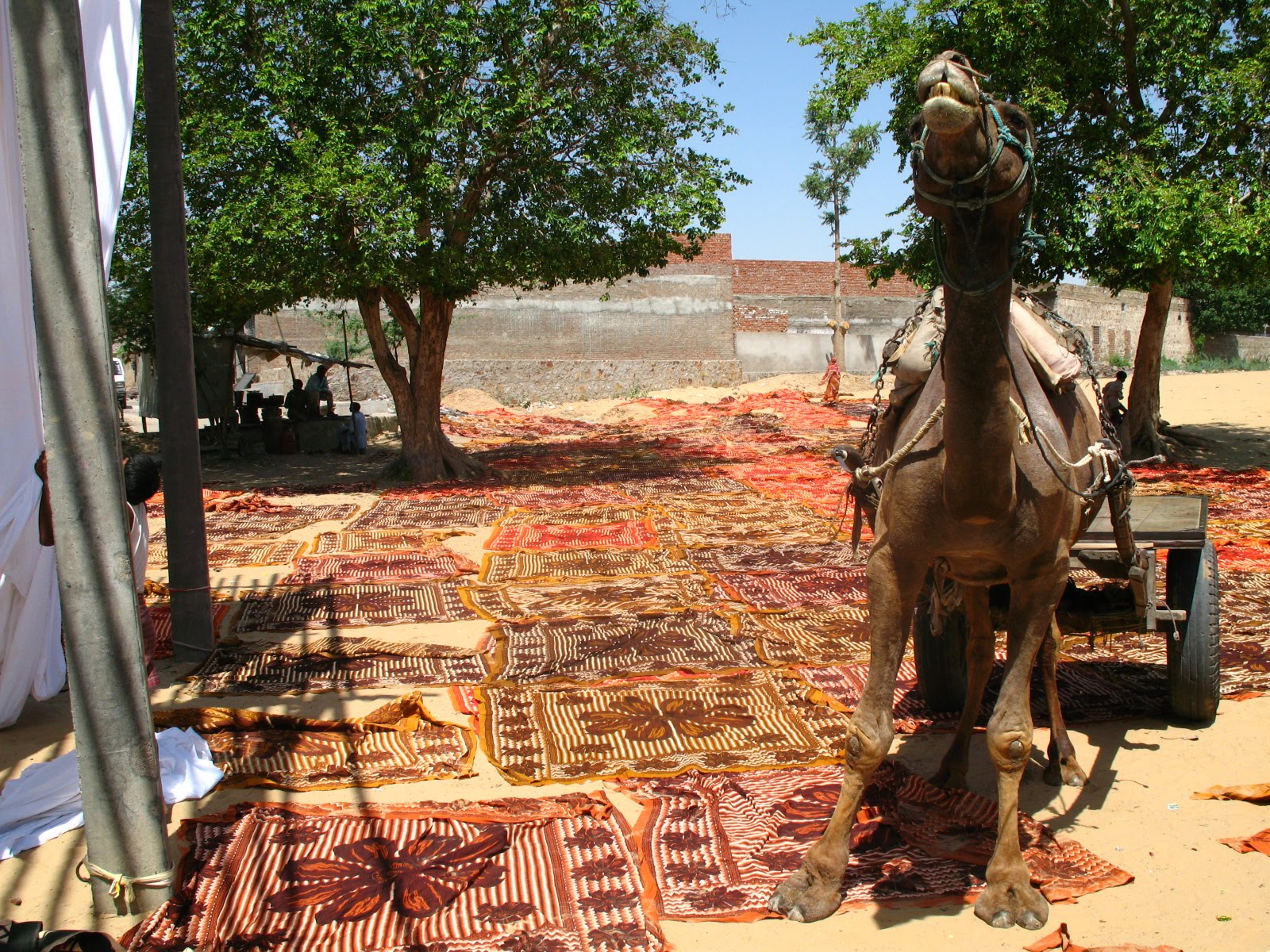
the textile part was a sizeable operation, bordered by orange saris of countless hues drying in the sun and under the feet of the odd camel.

we were led through the process with the fabric - mostly cotton - bleached, washed, dried and used in a whole host of ways. the environs were a combination of flowing, drape-like sheets waving in the breeze from hanging racks and coils of cloth being soaked in tanks.

the men seemed to do the washing while the women did the rest.

then on to the paper factory, which used cotton pulp for the paper. lots of big machines with no safety rails, while the woman in charge was clearly not one to be messed with! it was strange seeing Christmas wrapping and accoutrements bound for Europe being made in front of you in an Indian factory in April. we made a few purchases before being escorted to Philippa's favourite part, the block printing area.

this was the most engaging aspect of the tours. we'd been shown the mass production saris being printed by men working in teams of two at considerable speed, but the block printing was more of an artisan craft than a manufacturing process. it also appeared to be family run, using - of all things - old horse shoes soaked in molasses to form the base of the pigments. the centre runs three day courses for the interested. an incredibly wiry master craftsman put on a great display of the art, inviting us to put the finishing 'tocky tocky' touches to banging down the pigment-laden woodblocks.


we were told that he had 42 years' experience and, with his fluid movements and calm but very focused concentration, one could very easily believe it.

and so, to conclude - where else? - the shop. we spent a long time looking at potential items. Philippa picked up things for the flat, while Edd even managed to find something he liked, a Katha style embroidery jacket that fit everywhere! - except under the arms. the owner looked crestfallen, but so was Edd - maybe he'll make the next batch a little bigger.


surviving the sales pitch - wonder which one of these two didn't find anything that fit?

the prices in the shop were 'fixed,' both in terms of being non-negotiable and also probably in terms of being slightly shonky, but we were happy. we also got to see Yusef carrying around the bright pink bag containing our paper purchases, which looked rather fetching.

back at the hotel, we decided to send a load of additional things back in the post, since we had too much to carry with us in our small bags. we changed some money first at Thomas Cook, where one could not help but reflect that the armed guards at every such exchange are defending the contents with very long, old-style rifles - hardly practical for close combat with mischief makers or serious thieves.

sending the parcel was quite expensive and also something of a performance, as the items were hand-sewn into a cotton package before us, prior to the obligatory queue. line jumping was, as usual, frequently attempted and helps explain why people get so close to each other while waiting their turn.

we spent our final Jaipur night for a few days at least on the roof terrace of the Pearl Palace, watching bats swoop and change direction at speed while trying to ignore the two genuinely poor musicians who constituted the evening's entertainment. they had decided to park themselves next to our table and wail or mumble along to some very dubious sounding 'traditional' songs. as seems to happen every night in Jaipur, fireworks were going off across the city. we went to bed early, hoping to squeeze a breakfast in before checking out and getting our coach to Pushkar. it had been a fun day - no ancient sites for Edd (!), but plenty of ancient skills and a welter of colours and textures, like India itself.

stay in touch!

edd & philippa

Look Back In Amber

Wednesday 16th April

- Amber palace
- Anokhi Museum of Textile Design
- Jaigarh Fort


an earlier start than yesterday, as we planned a trip several kilometres North to visit Amber, the palace, fort and town that was previously the seat of power in these them parts before Jai Singh II moved the capital to the newly created Jaipur, the first such regional capital not to be based around a fortified defence. skipping breakfast and with no sign of Yusef for a barter for the journey, it was someone else's turn to be Driver of the Day (DOTD).

the first to step up to the plate started quoting silly prices and thus had his thunder stolen by Ravi, a pint-size, moustache-sporting rascal with more than a little twinkle in the eye and never in too much of a hurry to slow down and cast a glance over the passing ladies. it took us a while, but we eventually realised that he bore more than a passing resemblance to a short, Indian Des Lynam.

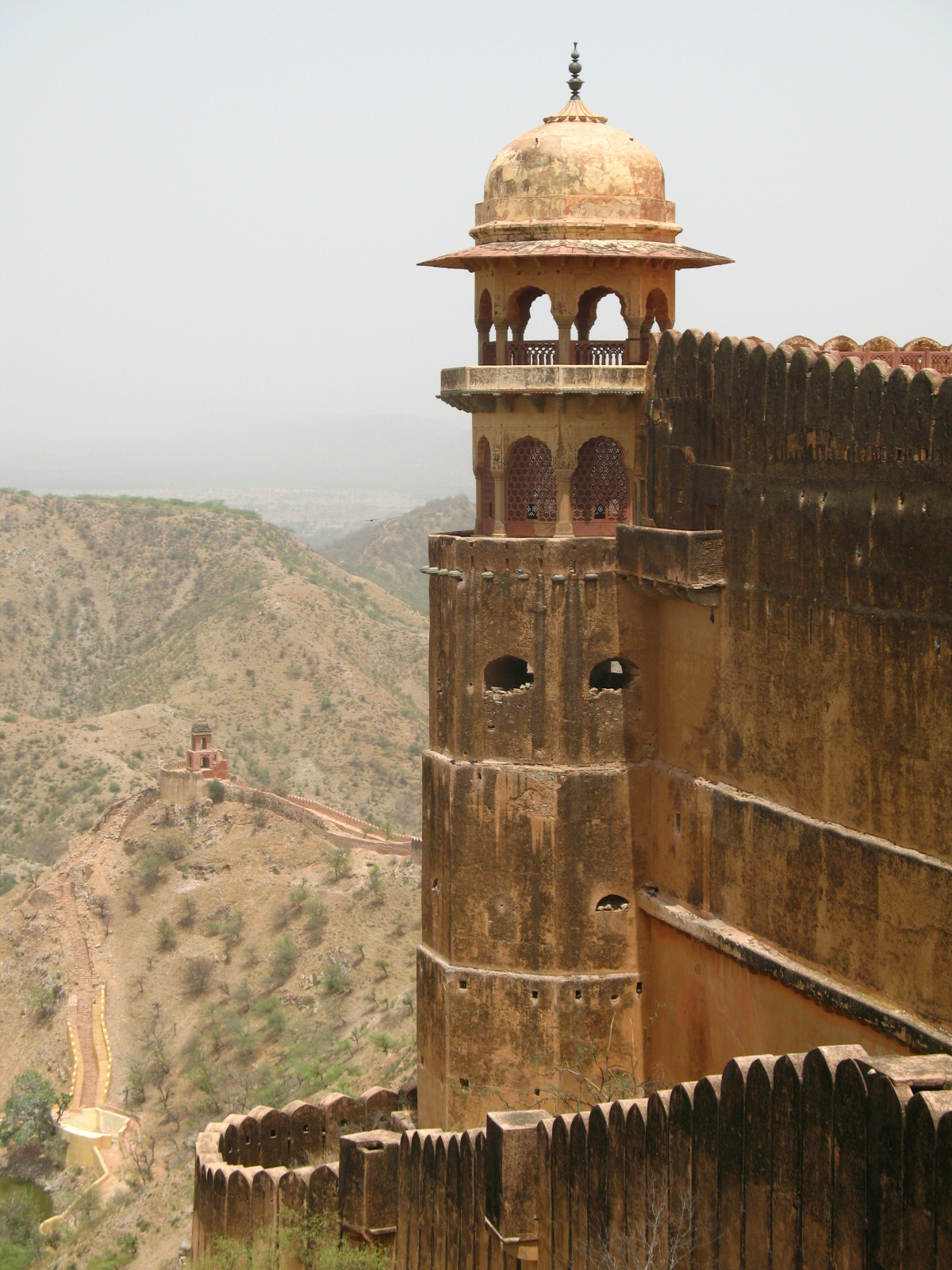
Amber lies 11 km North of Jaipur and Ravi took us across the top of the North walls of the city, full of small streets crowded with animals, vehicles and trash. the road runs beneath steep hills crowned by the Nahargarh fortress, whose long ramparts trip along their spine before ending in an embattlement emblazoned with a giant swastika high above us.

passing the Water Palace that we had seen the previous day, we noticed that there was another waterside complex of impressive buildings to one side of the lake. Amber and its sights lie further up the hill still and, during our day's rickshawing we noted a dead straight preserved grass boulevard with accompanying buildings that must once have linked it completely to the Water Palace, for whenever the maharajas felt like taking an air by the lake.

it was not long before Amber Palace itself appeared, flanked above and behind by the Jaigarh fort, the two presenting a solid face of ramparts, steep walls and winding paths in yellow and thick red sandstone respectively.


Jaigarh Fort and Amber Palace

in a natural space between craggy hills all around, a more defensible location would be hard to find. just walking up to its entrance along newer, twentieth century paths is an effort. you can also behave like a total and utter tourist and catch a gaudily decorated elephant up the route, but such a short distance for a fairly stiff fee seemed an easy opportunity to pass up, and we had already given some money towards the elephants' upkeep the day before (hopefully).

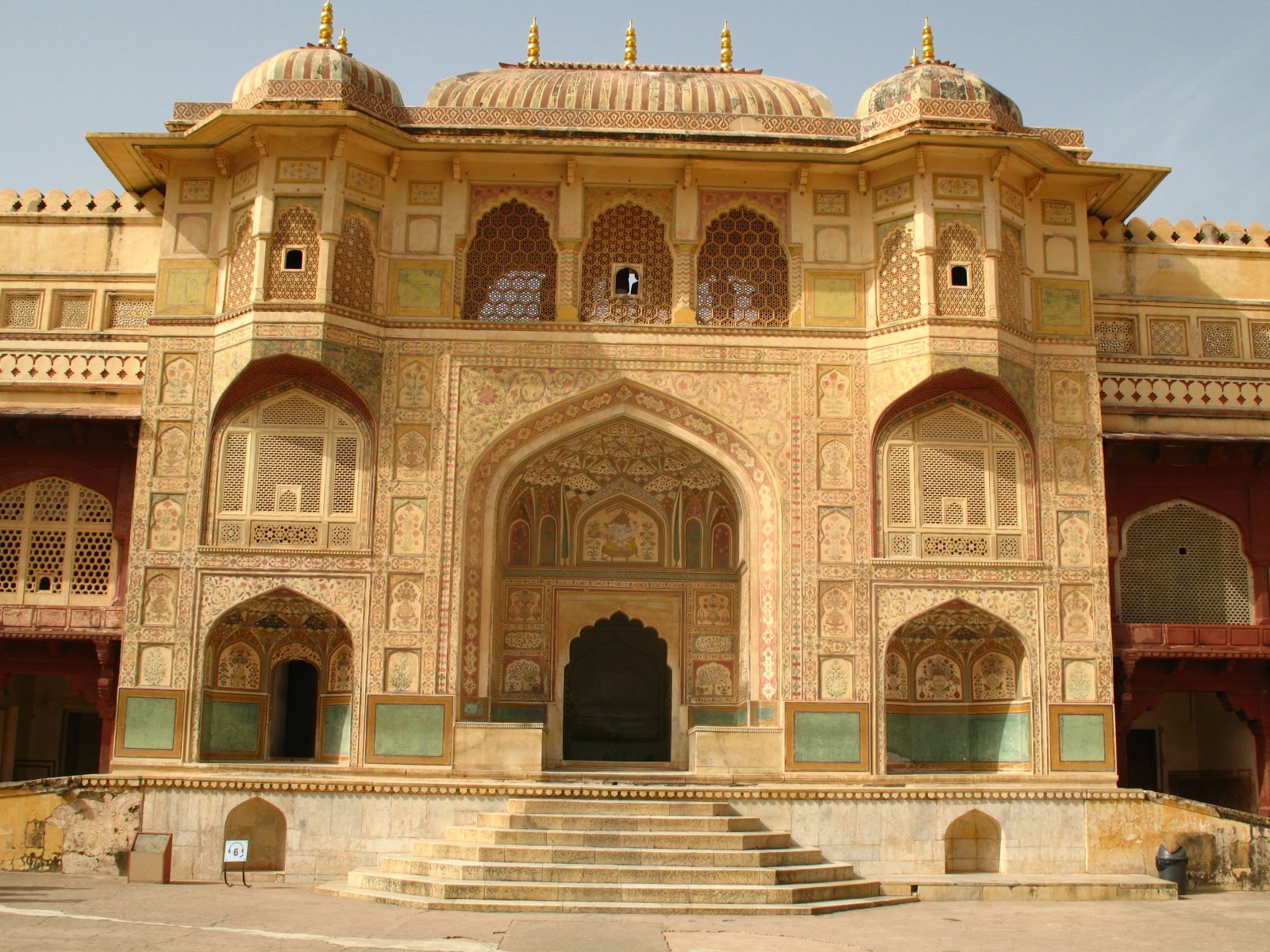
the palace is extensive and sprawling, although only a small portion of it is in excellent condition. that said, these sections are worth the trip alone. the Singh Pol (Lion Gate) and Ganesh Pol (er, Ganesh Gate) are both beautifully painted, the stone changing colour subtly as the sun rose higher.

Ganesh Pol

Ganesh Pol (detail)

Ganesh Pol (face in the window)

Mughal influences in the architecture can be seen in the arches and halls of public and private audience, the latter of which boasted walls and ceiling decorated with mosaics of mirror shards and coloured glass.


mirror fragment mosaic ceiling (detail)

intricate carved screen, Amber Palace, Jaipur

there was evidence here at least of attempts to restore the palace - a major tourist attraction - to something closer to its former glory, with teams of women transporting earth in baskets carried on their heads and men replanting and painting the palace's fountain-filled garden.

Indian man - hard at work

subtle

although we had been first in the queue for non-group bookings, it was not long before the quicker-visiting coach parties began to congregate in the major rooms. we managed to have our fill of them before they arrived and also to take our photographs at the exact spot immortalised on the cover of our Rough Guide to Rajasthan.

we then disappeared into the veritable warren of corridors, rooms and staircases that riddle the palace. the prettier basket-carrying women knew their potential and suggested photographs - for a fee, naturally.


one smiley security guard decided to show us the internal water tower. it was being restored and was absolutely full of bats, but the smell of guano was overpowering. he also directed us to the beehives hanging from the battlements, clearly just because he felt like it, beckoning us through a real labyrinth of secluded rooms and passageways.


on occasion, another latticed stone window would afford views of the steep, cobbled path up to the main gate, populated by progressively fewer elephants as the day heated up.


we half-attempted walking up to the Jaigarh fort, but it was a very steep climb of some duration and it was just too bright and hot, the total lack of anyone else on the path a good indicator of the sense of climbing up in the midday heat. we descended and renegotiated the cost of the day with Ravi, adding the Anokhi museum and site where they manufacture the block-printed products that we had seen in their shop in Jaipur as well as the Jaigarh fort to his itinerary.

we had a short hiatus trying to find fairly priced drinks. although the price is printed on all bottles, a common scam is to say that there is an Indian and a foreigner rate, as there is on entering monuments, or to claim additional charges for refrigeration, or a myriad of highly creative and unspecified 'taxes,' all of which are bogus. Ravi drove us through the quieter, narrower streets of the town to the Anokhi museum. meeting a cow in the road is an obstruction, but meeting an elephant in the road is a potential disaster.


Ravi steered us around those we met with some skill, even if - like Yusef - he seemed to find rickshaw driving a little too much like fun to worry about trifling concerns such as safety.

installed in an old haveli, the Anokhi museum was empty but for ourselves. it was good to see how extensive both the history of block printing and the museum itself were. a man in one corner of one room was busy carving out the wood blocks themselves, while another demonstrated the printing itself.

the range and variety of designs in the museum was far more involving and interesting than those in their Jaipur showroom.


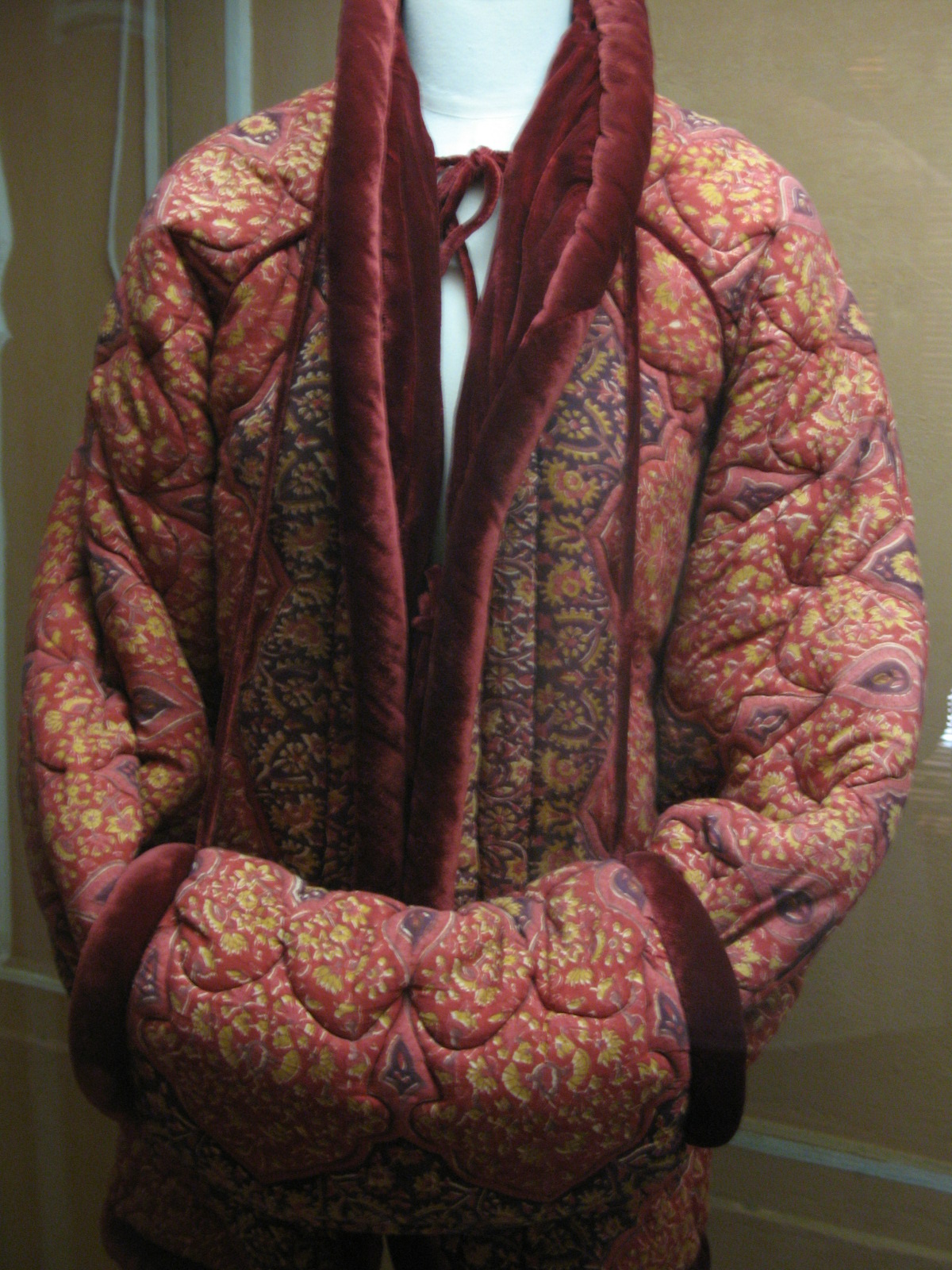
traditional Rajasthani block printed smoking jacket. probably.

a small shop again failed to accommodate Edd's size, the shirts again too small or short. by this time, Ravi had wandered in and it's always something else to consider when your DOTD is playing literally close attention to the cost of everything you are looking at, especially when he has already suggested you go to his mate's textile shop. everyone in India knows someone who knows someone, and the commission rickshaw drivers get for guiding tourists to shops usually outstrips their journey fares - and are added to your purchase costs.


Amber, as viewed from the Anokhi Museum - a town of temples and palaces.

Jaigarh fort was our final destination, a punishing, sidewinding path up a gradient that the rickshaw almost failed to climb. now lunchtime, the heat was intense. the fort itself is a real beast, situated in a position that must have been impossible to surmount and with one end peering over the Amber palace below.

built in 1600, the emphasis is much more on impregnability than design, encapsulated but its immense Jaivana cannon, the largest in Asia.

the views from up here and down the valleys are quite stunning, with the Water Palace a hazy blip in its artificial lake, on one side of which we now saw for the first time was the red stone rampart damn that had originally created it.

most of the fort is empty, now, and seems to be entirely covered with scratched graffiti. we've seen many signs at key sites politely asking people not to do this and there is even a television ad campaign. likewise, even up here the fort suffered from the same garbage and litter blight as the rest of the country. but, with a third of the country in poverty, historic site upkeep and litter are never going to be key considerations for a great many people.

the only guard we encountered here tried to sternly shunt us the way of a 'tips please' puppet show, the antithesis of his counterpart in the Amber palace. the displays and collections of the fort disappointed, but the hugely dramatic vistas kept on coming. when we reached the high rampart walls overlooking the palace, a verdant green enclosed garden area magically appeared, as refreshing as a cool drink.


Amber Palace, from the Jaigarh fort

we managed to steer ourselves around almost the entire fort before finding Ravi again. we gently coasted all the way down the hill road through gravity alone as he was low on fuel, which made avoiding the oncoming traffic something of a challenge. with vertiginous drops on many a bend, it was hardly a surprise that he considered it one of 'India's most dangerous roads.'

on the way back, as expected and acquiesced, we stopped off at a textile emporium known to Ravi. the owner - rather improbably named 'Aladdin' - showed us their workshop, allowing us to add strong solvents and gold paint to the bat guano Legionnaire's lungful cocktail for the day. a protracted display of products and much snake oil patter then followed, deflated somewhat by Philippa indicating sotto voce that several descriptions Aladdin gave of materials and prints weren't at all accurate. Ravi slumped nearby, looking a combination of tired, bored and hopeful. it's a very tough way to make a living, particularly when your ride doesn't see anything they want to buy.

our journey back took in the Northern roads once more, whose guttered roads were awash with piles of garbage and herds of pigs rooting contentedly around in the filth. cows flicked dust over themselves while donkeys laden with brick-filled saddlebags stumbled in the road ahead, Ravi almost driving straight into several of them.

we got back to the hotel eight hours after we left to find Yusef parked outside and visibly disappointed not to have caught our fare. we took the afternoon and evening easy, reflecting on the impressive range and marvellous variety of a rich and enjoyable day.

edd & philippa